Water Heater Installation and Repair in Brandon, FL
Need water heater repair in Brandon, FL? Request help for no hot water, leaking tanks, temperature problems, tankless error codes, electric or gas faults, replacement, and new installation.
- Tank and tankless repair
- Replacement and installation
- Leak and no-hot-water help
- Gas, electric, and heat pump
When Should You Request Water Heater Service?
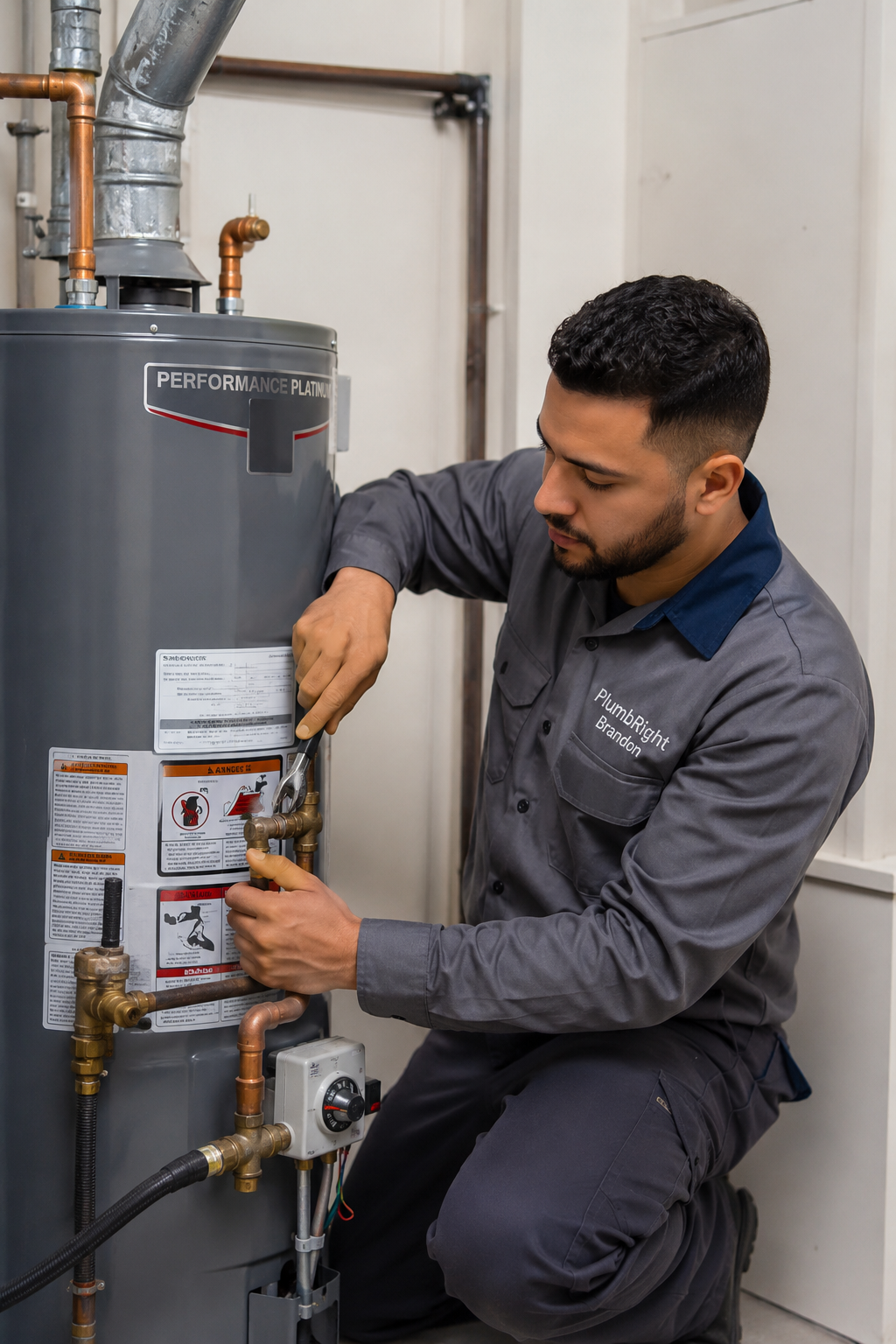
Request water heater service when there is no hot water, the temperature becomes unstable, the unit leaks, hot water runs out faster than normal, the tank makes rumbling noises, or a tankless heater repeatedly shuts down or displays an error code.
Possible causes include failed heating elements, thermostats, pilot or ignition parts, gas controls, sediment, scale, a leaking drain or relief valve, tank corrosion, blocked filters, flow sensors, venting, condensate, or equipment that no longer matches demand.
A leak from a pipe connection, drain valve, or serviceable relief component may be repairable. Water leaking through the body or corroded base of a storage tank generally supports replacement.
When water is spreading, electricity is affected, steam is escaping, or natural gas is suspected, stop using the heater and follow the emergency guidance below.
Call (656) 246-1108 or submit the form to describe the system and check current availability.
Which Water Heater Service Matches the Problem?
The heater, plumbing connections, power or fuel supply, venting, controls, water demand, and installation conditions may need to be assessed together.
| Water heater problem | Common warning signs | Relevant service |
|---|---|---|
| No hot water | Water remains cold at several fixtures | Electrical, ignition, thermostat, burner, or control assessment |
| Hot water runs out quickly | Short showers or slow recovery | Capacity, component, sediment, or dip-tube assessment |
| Water is too hot | Scalding or unstable temperature | Thermostat, sensor, control, or mixing-valve assessment |
| Water appears around the unit | Moisture near fittings, valves, pan, or tank base | Leak-source assessment |
| Tank makes popping sounds | Rumbling, popping, or cracking while heating | Sediment, scale, or component assessment |
| Pilot will not stay lit | Gas heater repeatedly loses flame | Pilot, sensor, thermocouple, gas control, or venting assessment |
| Breaker repeatedly trips | Electric heater loses power | Element, thermostat, wiring, or circuit assessment |
| Tankless error code | Unit stops heating or locks out | Model-specific tankless diagnostics |
| Existing unit repeatedly fails | Corrosion, unavailable parts, unreliable operation | Repair-versus-replacement assessment |
How Does a Water Heater Work?
A storage heater holds heated water inside an insulated tank. Cold water enters through the inlet, hot water exits through the outlet, and a burner or electric elements restore the selected temperature.
A tankless unit senses water flow and heats water through a heat exchanger. Output depends on flow rate, incoming-water temperature, available energy, and the required temperature rise.
A heat pump water heater stores hot water but transfers heat from surrounding air into the tank.
Common Water-Heater Components
- Storage tank or heat exchanger
- Cold inlet, hot outlet, and dip tube
- Heating elements or gas burner
- Thermostats and high-limit control
- Pilot, igniter, flame sensor, or thermocouple
- Gas-control or water-control valve
- Anode rod and drain valve
- Temperature and pressure relief valve
- Drain pan and expansion tank where applicable
- Tankless flow sensor, inlet filter, venting, condensate, and controller
Water Heater Repair in Brandon, FL
Request Brandon water heater repair when the system has stopped heating correctly but the tank or tankless heat exchanger may remain serviceable.
Why Is There No Hot Water?
- Tripped breaker or electrical supply loss
- Failed electric heating element
- Faulty thermostat or high-limit control
- Pilot, igniter, thermocouple, or flame-sensor failure
- Gas-control or burner problem
- Tankless filter, flow sensor, scale, venting, or condensate issue
Why Does Hot Water Run Out Quickly?
- Storage tank is undersized
- One electric element has failed
- Sediment reduces usable tank volume
- Dip tube is damaged
- Burner output is reduced
- Tankless demand exceeds flow capacity
- Hot and cold water cross through a faulty fixture
Why Is the Heater Noisy?
- Sediment near a burner or elements
- Mineral scale on heating surfaces
- Expanding and contracting metal
- Pressure or thermal-expansion conditions
- Loose components
- Internal tank deterioration
Why Is My Water Heater Leaking?
| Where water appears | Possible source |
|---|---|
| Top of the tank | Hot or cold connection, shutoff valve, connector, or nearby pipe |
| Around the relief valve | Relief valve, excessive pressure, thermal expansion, or discharge pipe |
| Near the drain valve | Loose, damaged, or partially open drain valve |
| Inside the drain pan | Tank leak, valve leak, connection leak, or relief discharge |
| Around the tank base | Tank corrosion, drain valve, concealed connection, or water running down the side |
| Beneath a tankless unit | Water fitting, relief component, condensate line, heat exchanger, or internal seal |
Why Is Water Dripping From the Relief Valve?
A temperature and pressure relief valve may discharge because of excessive temperature, excessive pressure, thermal expansion, a failed expansion tank, valve deterioration, debris, or an incorrect system condition.
Rusty, Cloudy, or Smelly Hot Water
When only hot water is affected, possible causes include tank corrosion, anode-rod deterioration, sediment, bacterial conditions, or hot-water piping. When both hot and cold water are affected, the source may involve incoming water or property piping.
For uncertain moisture or a nearby pipe leak, visit the plumbing repair and leak detection page.
Electric and Gas Water Heater Repair
Electric and gas systems use different heating and safety components, so troubleshooting should match the installed equipment.
| Electric water-heater problems | Gas water-heater problems |
|---|---|
| Failed heating element | Pilot will not light or stay lit |
| Faulty thermostat | Igniter failure |
| Tripped high-limit control | Flame-sensor or thermocouple problem |
| Repeated breaker trips | Gas-control valve fault |
| Slow recovery | Burner problem |
| Buzzing or burning odor | Combustion-air or venting problem |
Tankless Water Heater Repair and Replacement in Brandon, FL
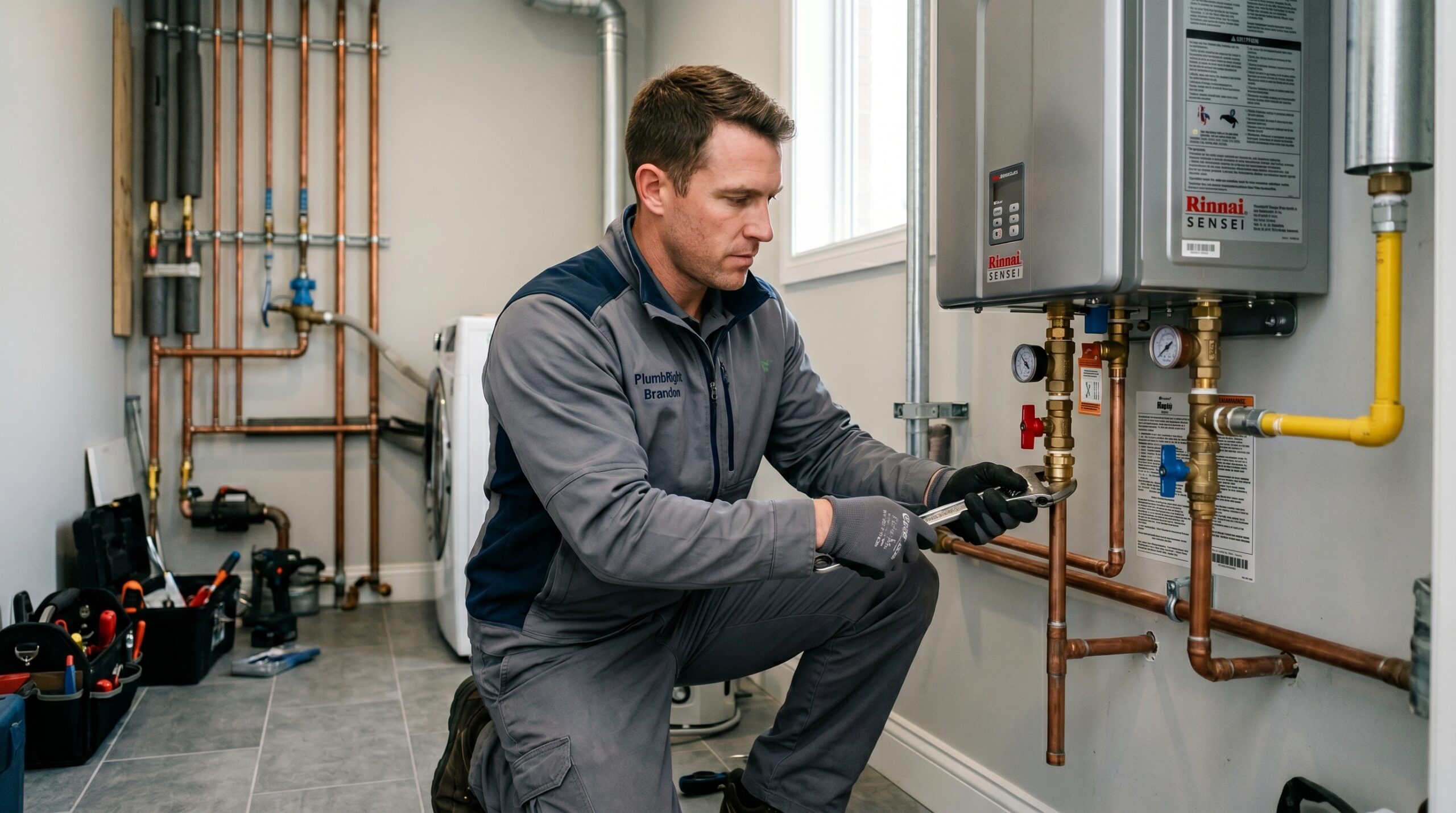
Request tankless service when the unit displays an error code, does not ignite, shuts down during use, has reduced flow, alternates between hot and cold water, leaks, or repeatedly requires resetting.
Common Tankless Problem Areas
- Cold-water inlet filter and flow sensor
- Water-control valve and heat exchanger
- Mineral scale and low flow
- Igniter, burner, and flame sensor
- Gas pressure or electrical capacity
- Venting, combustion air, and condensate
- Temperature sensors and control board
- Recirculation pump, check valves, and isolation valves
Why Does a Tankless Unit Go Cold?
Possible causes include low flow, demand above capacity, colder incoming water, a restricted filter, scale, inadequate gas or electrical input, a failed flow sensor, fixture crossover, or an error condition.
When Is Tankless Replacement Considered?
Replacement may be considered when the heat exchanger has serious damage, internal leakage continues, the unit repeatedly locks out, parts are unavailable, the system is permanently undersized, or repeated repairs are impractical.
Tankless Maintenance and Descaling
- Cleaning water inlet and air-intake filters
- Checking venting and condensate drainage
- Cleaning the condensate trap where applicable
- Flushing mineral scale from the heat exchanger
- Checking isolation valves and error history
- Testing operation after maintenance
Manufacturer Maintenance Guidance
Maintenance frequency depends on the model, water quality, usage, and scale conditions. Navien provides information on filter cleaning, condensate components, and heat-exchanger flushing in its tankless water-heater maintenance guidance.
When Do You Need Emergency Water Heater Repair in Brandon?
Request urgent help when a tank ruptures, water spreads rapidly, steam escapes, water reaches electrical equipment, or a gas leak is suspected.
- Storage tank has ruptured
- Water is spreading across the floor
- Water is entering a wall or ceiling
- Relief valve releases continuously
- Steam or dangerously hot water is escaping
- Hot- or cold-water pipe has separated
- Tankless unit is leaking internally
- Gas odor, hissing, soot, or abnormal flame is present
Immediate Water-Leak Steps
- Keep people away from hot water and wet electrical equipment.
- Stop using hot-water fixtures.
- Turn off the water-heater supply valve when it is safe and accessible.
- Switch off power only when the area and panel are dry and safely accessible.
- Never cap or plug the relief-valve discharge pipe.
What Should You Do if You Smell Gas?
Leave immediately, avoid switches and flames, call 911 from a safe location, and contact the gas utility from outside. Follow Peoples Gas natural-gas safety instructions.
Should the Water Heater Be Repaired or Replaced?
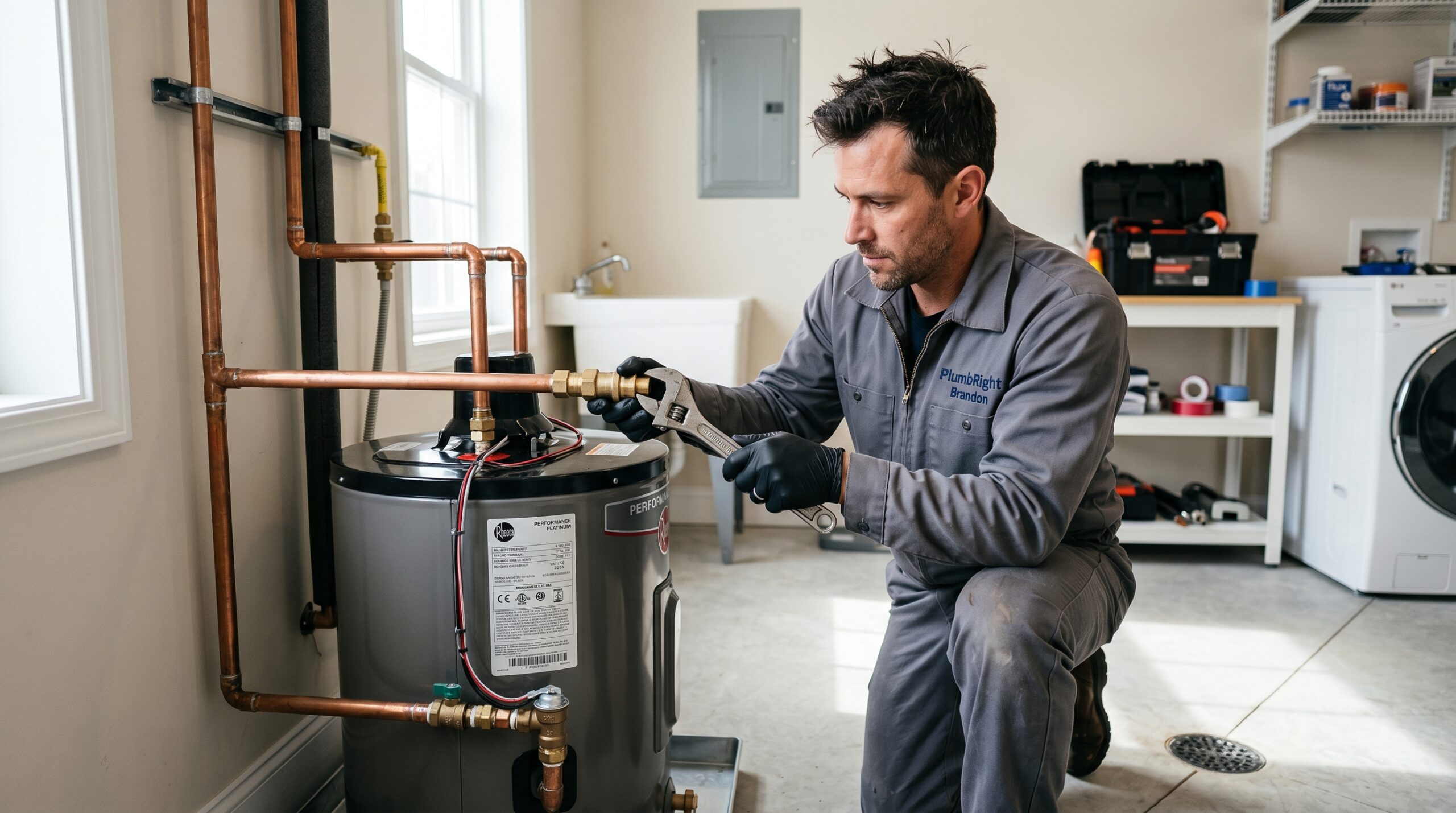
Age should not be the only deciding factor. Consider the leak source, tank or heat-exchanger condition, recent repairs, parts availability, capacity, fuel type, installation requirements, and repair cost.
| Water-heater condition | Repair may be appropriate | Replacement may be appropriate |
|---|---|---|
| Loose pipe connection | Connection can be repaired | Tank fitting or outlet is structurally damaged |
| Faulty drain valve | Valve can be replaced | Tank body also leaks |
| Failed electric element | Tank remains structurally sound | Tank is corroded or repeatedly failing |
| Pilot or ignition problem | Serviceable ignition part is responsible | Tank or heat exchanger has serious damage |
| Tankless error code | Filter, ignition, sensor, or scale issue can be corrected | Heat exchanger or control system has major failure |
| Water-heater leak | Leak comes from a fitting or valve | Water comes through the tank body |
| Insufficient hot water | Component, setting, or demand issue can be corrected | Unit is permanently undersized |
Water Heater Replacement in Brandon, FL
Brandon water heater replacement may involve removing the old unit, assessing the installation area, checking water, fuel, electrical, venting, pan, relief, and expansion requirements, and testing the new system.
Replacement May Include
- Disconnecting and draining the existing heater
- Checking the installation area and access
- Assessing shutoff valves and water connections
- Reviewing the drain pan and relief discharge
- Checking expansion-control requirements
- Confirming gas, electrical, venting, or condensate needs
- Connecting, filling, leak testing, and operational testing
How Long Does Replacement Take?
Timing depends on the unit type, location, access, water connections, gas or electrical requirements, venting, condensate drainage, permit or inspection requirements, and whether the replacement matches the old configuration.
A straightforward replacement generally requires less work than converting between tank, tankless, gas, electric, or heat-pump systems. The expected scope should be confirmed after assessment.
Water Heater Installation in Brandon, FL
Installation should begin with the property’s actual hot-water demand and the selected unit’s fuel, electrical, venting, drainage, clearance, and service requirements.
What Should Be Checked Before Installation?
- Occupants, bathrooms, and simultaneous hot-water use
- Laundry, dishwasher, and large-tub demand
- Existing fuel source and electrical-panel capacity
- Gas-pipe capacity, venting, and combustion air
- Installation space, clearances, drain pan, and drainage
- Condensate routing, water pressure, and thermal expansion
- Recirculation, unit dimensions, permits, and inspections
Hillsborough County explains that many property improvements require approval or permits depending on scope. Review its homeowner permit guidance.
How Is a Storage Water Heater Sized?
- Peak-hour demand and first-hour rating
- Tank capacity and recovery rate
- Number of occupants and bathrooms
- Simultaneous fixtures, laundry, and dishwasher use
- Incoming-water temperature and fuel type
A larger tank is not automatically better. Oversizing may increase space and standby-energy needs, while undersizing may cause shortages.
How Is a Tankless Water Heater Sized?
- Required gallons per minute
- Simultaneous fixtures
- Incoming and desired outlet temperatures
- Required temperature rise
- Gas or electrical capacity
- Minimum activation flow and recirculation demand
A tankless system can heat water continuously, but it still has a maximum flow and temperature-rise capacity.
Can a Tank Be Replaced With Tankless?
A conversion may require assessment of peak flow, temperature rise, gas-pipe or panel capacity, venting, condensate drainage, mounting, water lines, isolation valves, recirculation, permits, and inspections.
What Work May Require Another Trade?
- New electrical panel or high-amperage circuit
- Major gas-pipe replacement or meter upgrade
- Chimney repair or extensive vent rerouting
- Framing, structural, cabinet, or roof work
- Water-damage or mold remediation
- New utility service or whole-property repiping
Which Water Heater Type Fits the Property?
| Water-heater type | How it operates | Main considerations |
|---|---|---|
| Electric storage tank | Electric elements heat stored water | Tank size, first-hour rating, circuit, elements, thermostats |
| Gas storage tank | Gas burner heats stored water | Gas supply, venting, combustion air, capacity, recovery |
| Gas tankless | Burner heats water as it flows | GPM, temperature rise, gas capacity, venting, condensate |
| Electric tankless | Electric elements heat water on demand | High electrical demand, panel capacity, GPM, temperature rise |
| Heat pump or hybrid | Transfers heat from surrounding air into stored water | Air volume, room temperature, condensate, electrical supply, tank size |
| Point-of-use heater | Small unit serves a nearby fixture | Limited demand and local electrical or plumbing requirements |
Water Heater Maintenance in Brandon
Maintenance needs vary by system, manufacturer, water quality, usage, installation conditions, and previous scale or sediment.
Storage-Tank Maintenance May Include
- Checking for leaks and connection damage
- Inspecting the drain pan and relief discharge
- Reviewing pressure and thermal expansion
- Flushing sediment where appropriate
- Checking the anode rod and drain valve
- Inspecting burner, elements, and gas venting
- Reviewing temperature settings and operation
Tankless Maintenance May Include
- Cleaning inlet and air filters
- Flushing mineral scale
- Inspecting the heat exchanger and venting
- Checking condensate components
- Inspecting isolation valves and recirculation
- Reviewing error history and outlet temperature
- Checking for visible leaks
What Temperature Should a Water Heater Be Set To?
The U.S. Department of Energy says approximately 120°F is suitable for many households, although appliance requirements, health considerations, and scald protection may affect the correct setting.
Review the Department of Energy water-heater temperature guidance.
Why Fixture Temperature Can Differ
- Thermostat accuracy
- Pipe distance and heat loss
- Recirculation
- Mixing valves
- Fixture cartridges
- Tank stratification
- Incoming-water temperature
Extremely hot or unstable water may indicate a thermostat, sensor, control, or mixing-valve problem.
How Does Water Heater Service Work?
Clear information about the system type, leak location, hot-water symptoms, error codes, power, fuel, and installation area helps identify the relevant next step.
Describe the System
Explain whether it is tank, tankless, gas, electric, heat pump, residential, or commercial.
Share the Symptoms
Mention no hot water, a leak, temperature changes, noise, odor, a breaker issue, or an error code.
Identify the Source
The heater, water connections, controls, power or fuel, venting, valves, and water conditions can be checked.
Compare Options
Review repair, maintenance, replacement, installation, or work that may need another trade.
Test the System
Check leaks, heating or ignition, outlet temperature, flow, venting, condensate, and shutoff operation.
What Affects Water Heater Service Costs in Brandon?
Cost depends on the system, problem, parts, installation location, access, and whether the work involves repair, replacement, installation, or maintenance.
Water Heater Service in Brandon and Nearby Areas
Request water heater help in Brandon and nearby communities. Availability depends on property location, system type, problem, required work, and the current schedule.
Explore additional services from a plumber in Brandon, FL.
Related Plumbing Services
Hot-water symptoms may involve the water heater, a leaking pipe, a shower or faucet, appliance connection, commercial distribution system, or urgent water problem.
Frequently Asked Questions
What are the signs that a water heater needs repair?
Can a leaking water heater be repaired?
Why is there no hot water?
Why does hot water run out quickly?
Should I repair or replace my water heater?
Do you install tank and tankless water heaters?
Can a tank water heater be converted to tankless?
What temperature should a water heater be set to?
Is a gas smell near the water heater an emergency?
How long does water heater replacement take?
Request Water Heater Help in Brandon
A leaking tank, cold shower, unstable temperature, tankless error code, electrical trip, ignition problem, or reduced hot-water supply may indicate that the system needs assessment. Describe the heater type, symptoms, leak location, and whether gas or electricity may be affected.